
On‑Call vs. Scheduled Medical Waste Disposal: What California Law Requires
7/15/2025
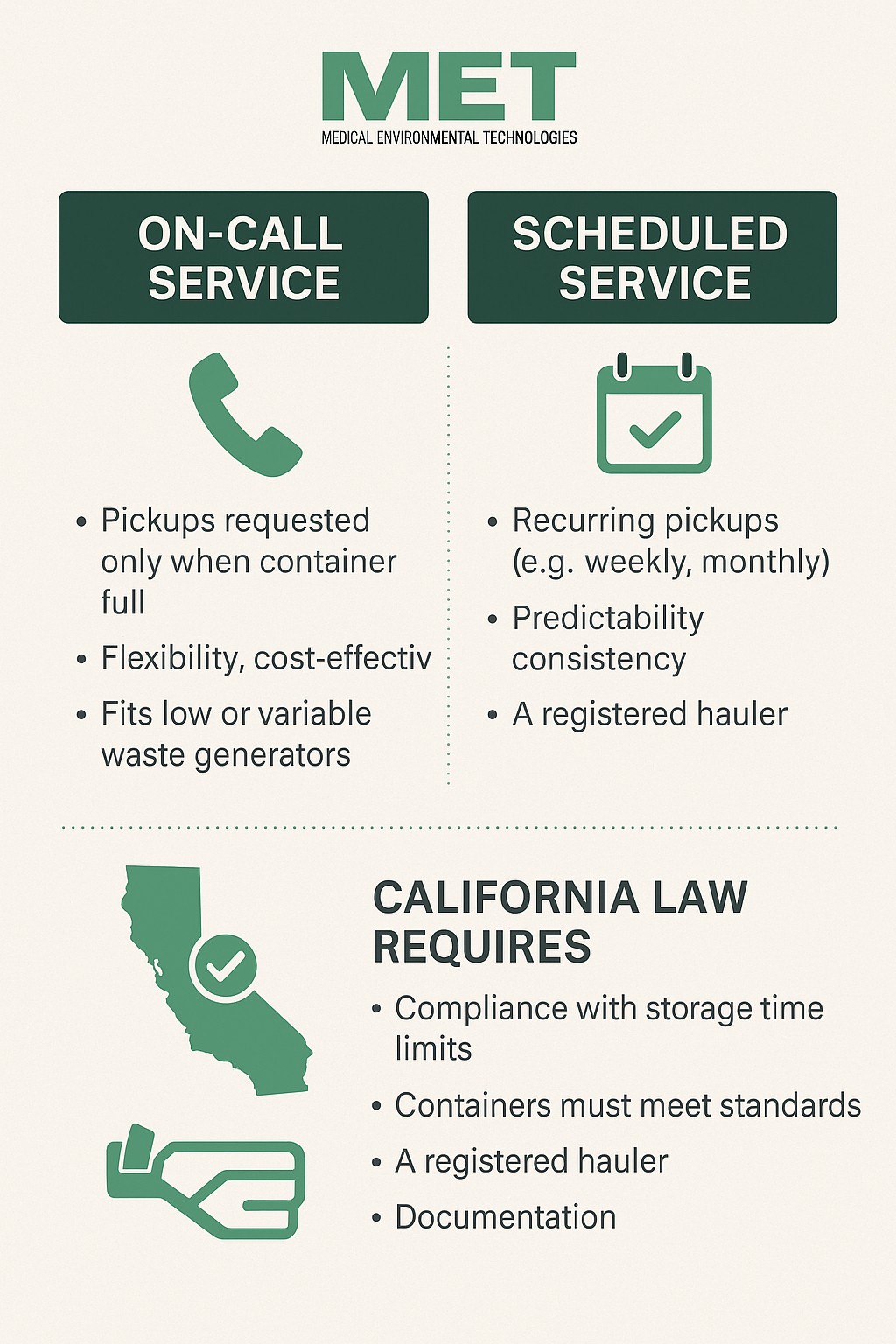
At MET (Medical Environmental Technologies), we help healthcare providers manage regulated waste with services that are not only convenient, but also compliant with California law. This article outlines the difference between on-call and scheduled pickups and explains what the law says about proper disposal in California.
Service Options Explained
On‑Call Service is ideal for low or variable waste generators such as dental offices, veterinary clinics, and med spas. You request a pickup only when your container is full. It’s flexible, cost-effective, and eliminates unnecessary service stops.
Scheduled Service is best for higher-volume generators such as hospitals, surgical centers, and labs. Waste is picked up on a consistent schedule weekly, monthly, or quarterly ensuring regulatory compliance without requiring you to monitor fill levels.
MET offers both options and allows clients to switch at any time based on their needs.
What California Law Requires
California’s Medical Waste Management Act (MWMA) governs the handling, storage, transportation, and treatment of medical waste. Here's how it applies to your waste service schedule:
1. Storage Time Limits
-
Medical waste must be removed within 7 days if your facility generates more than 20 pounds per month.
-
For facilities generating less than 20 pounds per month, waste can be stored for up to 30 days.
-
Waste may be stored for longer only if kept at or below 32°F (e.g., in cold storage).
-
Sharps containers must be disposed of within 30 days once full.
2. Container Standards
-
All medical waste must be stored in rigid, leak-resistant, puncture-resistant containers with tight-fitting lids.
-
Containers must be clearly labeled with the universal biohazard symbol.
-
Sharps must be stored in FDA-approved sharps containers.
3. Transport Requirements
-
Only registered medical waste haulers are allowed to transport waste offsite.
-
Each pickup must be documented on a medical waste tracking form (manifest) that records the generator, type of waste, quantity, and destination.
-
These manifests must be retained by both the generator and transporter for a minimum of three years.
4. Treatment & Disposal
-
Waste must be treated using approved methods such as autoclaving, incineration, or chemical disinfection at a permitted treatment facility.
-
Pharmaceutical and chemotherapy waste typically requires incineration.
5. Documentation
-
Facilities must maintain written procedures, training records, waste tracking manifests, and treatment logs.
-
These records must be kept for two years (small quantity generators) or three years (large quantity generators).
Does California Law Require a Pickup Schedule?
California law does not require a specific pickup frequency. However, your service schedule must ensure that:
-
You do not exceed storage time limits (7 or 30 days, depending on volume)
-
Waste is handled and removed by a registered hauler
-
Documentation and manifests are maintained
-
Containers meet all storage and labeling requirements
If your on-call pickups happen frequently enough to comply with these rules, you're within the law. If not, a scheduled service may be required to avoid violations.
How MET Ensures Compliance
-
We track your accumulation time and send reminders to avoid exceeding limits
-
All containers we provide meet California's storage standards
-
We’re a registered and permitted transporter handling your paperwork and documentation
-
We offer flexible service options to match your waste generation pattern